
Science Just Proved What TCM Has Always Known
A landmark discovery reveals the anatomical basis of how acupuncture works — and confirms what Traditional Chinese Medicine has mapped for thousands of years.
Acupuncture works. People seek it out for chronic pain, migraines, anxiety, insomnia, fertility, and more, and the outcomes and research consistently support its effectiveness. But for decades, one question has lingered: how does it work? What is actually happening in the body when a needle is placed at a precise point along a meridian?
A landmark article published this month in The New York Times may finally have the answer. And it begins — improbably enough — with a tattoo study.
The Discovery
In 2021, researchers studying people with tattoos noticed something unexpected in their biopsies: ink particles had traveled far deeper into the body than anticipated — through the skin, into an interstitial space beneath it, and from there into the fascia below. The fluid was moving through a pathway between two tissue layers no one knew were connected in this way.
What followed was the unraveling of a much larger secret. That space, it turned out, wasn't isolated. There are spaces like it throughout the entire body — surrounding organs, running alongside blood vessels, threading through muscle — forming a vast, continuous network of fluid-filled pathways. Scientists now call this the interstitium. It may be the body's third circulatory system, joining the cardiovascular and lymphatic systems that Western medicine has known about since 1622 and 1628 respectively.
The Proof That Points Follow Meridians
Here is where it gets extraordinary. Researcher Andrew Ahn of the Osher Center in Boston injected a fluorescent dye into the Pericardium 6 acupoint on the inner forearm — and watched it slowly migrate through interstitial spaces and reappear, with remarkable accuracy, at the Pericardium 3 acupoint on the inside of the elbow. The dye had traveled the meridian.
"This pathway doesn't go in the veins, it doesn't go superficially. When I saw that, I said: 'We're onto something. This truly has to do with acupuncture.'"
— ANDREW AHN, OSHER CENTER, QUOTED IN THE NEW YORK TIMES MAGAZINE
Separately, Harvard researcher Harriet Langevin mapped acupuncture points onto anatomical cross-sections of the human arm and found an 80% overlap with connective tissue planes — precisely the territory of the interstitium. This was not coincidence. It was structure. When a needle is placed at an acupoint, it creates a mechanical response that propagates through this interstitial network, altering fluid dynamics and cellular signaling far beyond the needle's location.
Ancient Medicine Had a Name for This
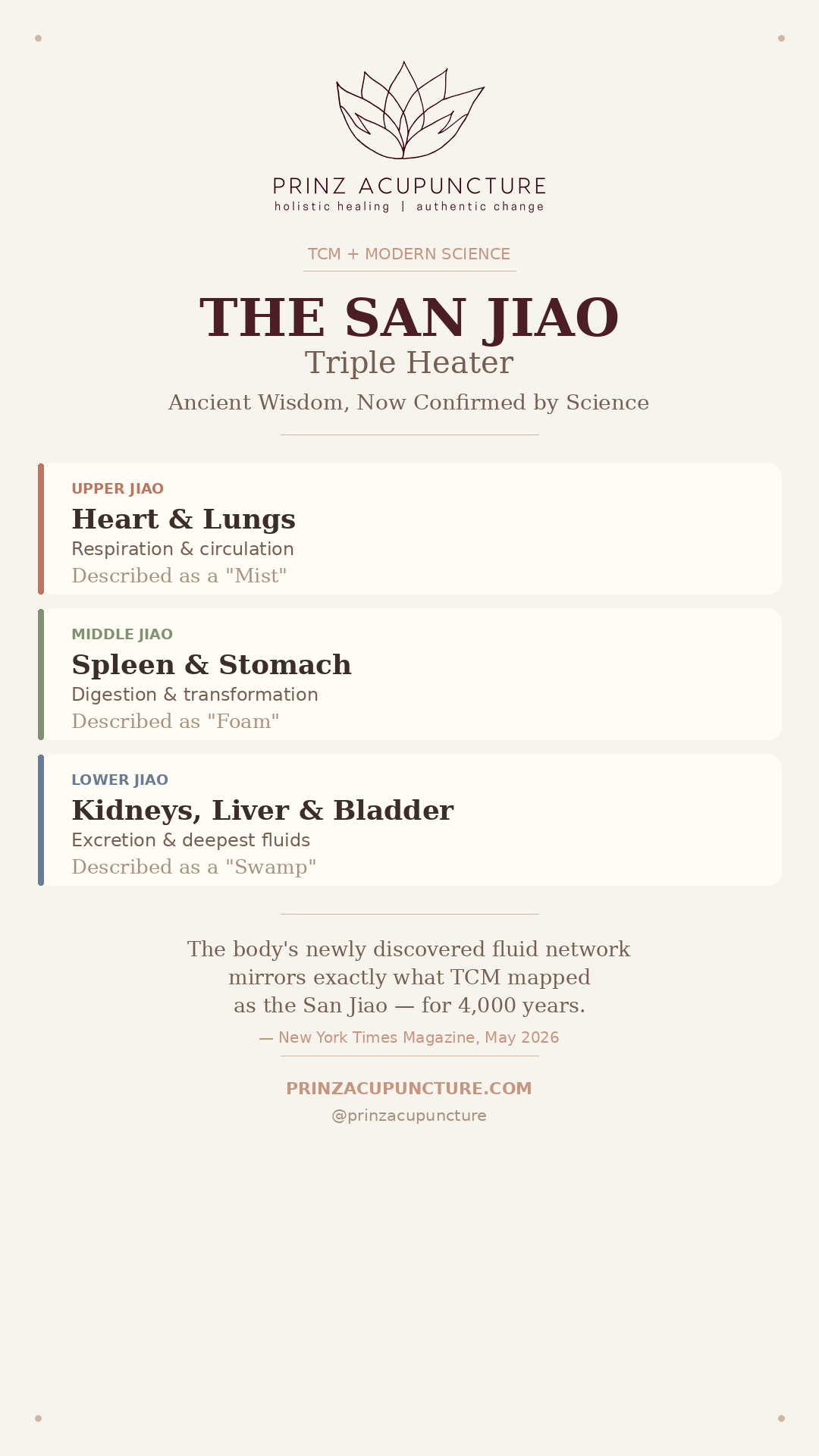
None of this surprises those of us trained in Traditional Chinese Medicine. We have always understood the body as a unified, fluid system — and we have always had a name for the network that governs it: the San Jiao, or Triple Heater. Classical texts describe it as the "official who plans the waterways" and the "minister of dredging." Unlike the Heart, Liver, or Kidneys, the San Jiao has no single discrete anatomical structure — it is not an organ in the Western sense, but rather a function: the great integrating system through which Yuan Qi, our foundational constitutional energy, travels from the Kidneys to nourish every organ system in the body. Its domain is the movement and transformation of all fluids — and now, Western science has a name for it too.
What Western medicine is now calling the interstitium — a body-wide fluid network involved in cellular communication, immune signaling, and the distribution of vital substances — is a near-perfect anatomical description of the San Jiao. As the Times noted wryly: mention the interstitium to an acupuncturist and you might get an eye roll, like, "No kidding."
Why This Matters for Your Health
The interstitium is now believed to play a central role in how inflammation moves through the body, how immune cells migrate to sites of need, how cancer spreads, and how healing happens systemically. For instance, for those on a fertility journey, the San Jiao governs the fluid environments in which eggs mature and embryos implant. When we work to support your fertility through acupuncture, we are — through the lens of this new science — optimizing the interstitial environment: reducing inflammation, supporting lymphatic drainage, and regulating the hormonal signals that move through this fluid network.
For decades, patients who chose acupuncture were told there was "no anatomical basis" for meridians. Those patients — and their practitioners — knew otherwise. They had experienced it. Now the science is catching up. The body is not a collection of separate systems but a unified, fluid, dynamic whole. An acupuncture needle placed with intention at a precise location, along a pathway mapped more than two thousand years ago, is doing something real.
We always knew the San Jiao was there. Now the rest of the world is starting to see it too.
Erika Prinz, L.Ac. is a licensed acupuncturist with over 14 years of clinical experience, specializing in fertility support, reproductive health, and pain care through Traditional Chinese Medicine. She practices at Prinz Acupuncture in West Chester, PA and New York City.
Sources: Benias et al., Scientific Reports (2018); Langevin et al., connective tissue / acupuncture mapping; Ahn et al., Osher Center fluorescent dye studies; Cooper, A.Z., New York Times Magazine, "Inside the Interstitium" (May 11, 2026)., Stilton, S., New York Times, “It’s All Connected, (May 11, 2026)